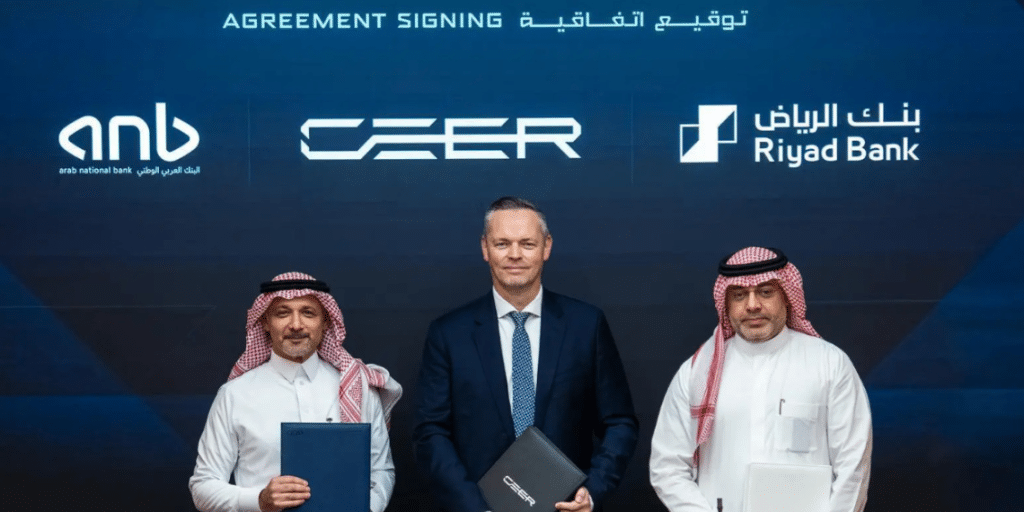
Saudi Arabia's electric vehicle manufacturer CEER has secured SAR 2.6 billion, approximately $693 million, in financing from Riyad Bank and Arab National Bank, reinforcing domestic banking support for one of the Kingdom's strategic industrial diversification projects.
The financing was reported by the Saudi Press Agency and subsequently covered by Zawya on 19 November 2026.
CEER is a joint venture between Saudi Arabia's Public Investment Fund and Taiwan's Foxconn. Established to develop a domestic electric vehicle manufacturing industry, the company forms part of the broader economic diversification objectives of Saudi Vision 2030.
The new financing is intended to support operational readiness and the company's long-term commercial development as it moves towards vehicle production and distribution.
CEER unveiled its first two electric vehicle models in September 2026 and plans to introduce five further models by 2030. Its initial sedan and sport utility vehicle models are expected to enter the Saudi market in early 2027.
For Riyad Bank and Arab National Bank, the transaction represents exposure to an industrial development project with substantial strategic significance but also the commercial risks associated with establishing an automotive manufacturing business.
Electric vehicle production is capital intensive, requiring significant investment in manufacturing infrastructure, supplier relationships, technology development, inventories and distribution capabilities before the business can establish a reliable operating cash flow.
These characteristics make financing structures particularly important. The timing of funding commitments, capital expenditure and expected commercial revenues can materially influence liquidity requirements during the development phase.
The presence of the Public Investment Fund as a joint venture shareholder provides an important institutional dimension, although it should not be interpreted as an unconditional guarantee of the company's financial obligations.
The publicly available announcement does not disclose the facility's maturity, pricing, security package or detailed repayment structure. Consequently, its risk allocation and credit economics cannot be independently assessed from the reported information.
The agreement nevertheless illustrates the expanding role of Saudi banks in financing non-oil industrial development alongside conventional corporate lending and infrastructure projects.
As the Kingdom's investment programme advances, the ability of domestic lenders to finance large industrial borrowers while maintaining adequate liquidity, capital buffers and portfolio diversification will become increasingly important.